VOLTAGE CONVERTERS

VOLTAGE ACCESSORIES

COMPANY INFORMATION

VOLTAGE CONVERSION GUIDE
|
A History of Plugs and Sockets
The first uses of electricity in the domestic environment were primarily for lighting. However, as electricity became a viable alternative to other means of heating and was gaining applications in labor saving devices, a way of connecting to the electricity supply other than using a light socket was needed. The solution was a two-prong plug, which made its first appearance in the 1920s.
In the early days, it was not unusual for electricity companies to have a split tariff system, with the cost of electricity for lighting lower than for other purposes. This led to low wattage appliances like vacuum cleaners, hair dryers, etc being connected to the light socket. The picture below is of a 1909 electric toaster with a light bulb connecting socket plug.
As safety with electricity became a greater concern, three-pin outlets were developed. The third pin on the outlet was an earth pin, which was effectively connected to earth, this being at the same potential as the neutral supply line. In the event of a short circuit to earth, a fuse would blow, disconnecting the supply.
The reason why we are now stuck with no less than 13 different styles of plugs and wall outlets, is because many countries preferred to develop a plug of their own, instead of adopting the US standard.
Summary of Plugs and Sockets used Around the World
The following is a brief outline of the plugs and sockets used around the world in the domestic environment. The outline map below visualizes the spread of the different plug types used around the world. For easy reference, compatible plug types are represented with the same color.

TYPE A |
| (used in, among others, North and Central America
and Japan) |
 |
This class II ungrounded plug with two flat
parallel prongs is pretty much standard in most of North and Central America.
At first glance, the Japanese plug and socket seem to be identical to
this standard. However, the Japanese plug has two identical flat prongs,
whereas the US plug has one prong which is slightly larger. Therefore
it is no problem to use Japanese plugs in the US, but the opposite does
not work often. Furthermore, Japanese standard wire sizes and the resulting
current ratings are different than those used on the American continent.
Type A and B plugs have two flat prongs with a hole near the tip. These
holes aren't there without a reason. If you were to take apart a type
A or B socket and look at the contact wipers that the prongs slide into,
you would find that in some cases they have have bumps on them. These
bumps fit into the holes so that the outlet can grip the plug’s
prongs more firmly. This prevents the plug from slipping out of the socket
due to the weight of the plug and cord. It also improves the contact between
the plug and the outlet. Some sockets, however, don't have those bumps
but just two spring-action blades that grip the sides of the plug pin,
in which case the holes aren't necessary.
There are also some special outlets which allow you to lock the cord
into the socket, by putting rods through the holes. This way, for example
vending machines cannot be unplugged. Moreover, electrical devices can
be "factory-sealed" by the manufacturer using a plastic tie
or a small padlock through one or both of the plug prong holes. For example,
a manufacturer might apply a plastic band through the hole and attach
it to a tag that says: "You must do X or Y before plugging in this
device". The user cannot plug in the device without removing the
tag, so the user is sure to see the tag. |
TYPE B |
| (used in, among others, North and Central America
and Japan) |
 |
This is a class I plug with two flat parallel
prongs and a grounding pin (American standard NEMA 5-15/Canadian standard
CS22.2, n°42). It is rated at 15 amps and although this plug is also
standard in Japan, it is less frequently used than in North America. Consequently,
most appliances sold in Japan use a class II ungrounded plug. As is the
case with the type A standard, the Japanese type B plugs and sockets are
slightly different from their American counterparts.
An ungrounded version of the North American NEMA 5-15 plug is commonly
used in Central America and parts of South America. It is therefore common
for equipment users to simply cut off the grounding pin that the plug
can be mated with a two-pole ungrounded socket. |
TYPE C |
| (used in all countries of Europe except the
United Kingdom, Ireland, Cyprus and Malta) |
 |
| This two-wire plug is ungrounded and has two
round prongs. It is popularly known as the europlug which is described in
CEE 7/16. This is probably the single most widely used international plug.
It will mate with any socket that accepts 4.0 - 4.8 mm round contacts on 19
mm centres. The plug is generally limited for use in class II applications
that require 2.5 amps or less. It is, of course, unpolarised. It is commonly
used in all countries of Europe except the United Kingdom and Ireland. It
is also used in various parts of the developing world. Whereas type C plugs
are very commonly used, this is not the case for type C sockets. This kind
of socket is the older and ungrounded variant of socket types E, F, J, K
and L. Nowadays most countries demand grounded sockets to be installed in
new buildings. Since type C sockets are ungrounded, they are currently being
phased out in many countries and replaced by type E, F, J, K or L (depending
on the country). A type C plug fits perfectly into a type E, F, J, K or
L socket. |
TYPE D |
| (used almost exclusively in India, Sri Lanka,
Nepal and Namibia) |
 |
India has standardised on a plug which was
originally defined in British Standard 546 (the standard in Great Britain
before 1962). This plug has three large round pins in a triangular pattern.
It is rated at 5 amps. Type M, which has larger pins and is rated at 15
amps, is used alongside type D for larger appliances in India, Sri Lanka,
Nepal and Namibia. Some sockets can take both type M and type D plugs.
Although type D is now almost exclusively used in India, Sri Lanka, Nepal
and Namibia, it can still occasionally be found in hotels and theatres
in the UK and Ireland. It should be noted that tourists should not attempt
to connect anything to a BS546 round-pin outlet found in the UK or Ireland
as it is likely to be on a circuit that has a special purpose: e.g. for
providing direct current (DC) or for plugging in lamps that are controlled
by a light switch or a dimmer.
|
TYPE E |
| (primarily used in France, Belgium, Poland, Slovakia,
the Czech Republic, Tunisia and Morocco) |
 |
| France, Belgium and some other countries have
standardised on a socket which is different from the CEE 7/4 socket (type
F) that is standard in Germany and other continental European countries.
The reason for incompatibility is that grounding in the E socket is accomplished
with a round male pin permanently mounted in the socket. The plug itself
is similar to C except that it is round and has the addition of a female
contact to accept the grounding pin in the socket. In order to bridge the
differences between sockets E and F, the CEE 7/7 plug was developed (see
photo above): it has grounding clips on both sides to mate with the type
F socket and a female contact to accept the grounding pin of the type E
socket. The original type E plug, which does not have grounding clips, is
no longer used, although very rarely it can still be found on some older
appliances. Note that the CEE 7/7 plug is polarised when used with a type
E outlet. The plug is rated at 16 amps. Above that, equipment must either
be wired permanently to the mains or connected via another higher power
connector such as the IEC 309 system. A type C plug fits perfectly into
a type E socket. |
TYPE F |
| (used in, among others, Germany, Austria, the
Netherlands, Sweden, Norway, Finland, Portugal, Spain and Eastern Europe)
|
 |
Plug F, known as CEE 7/4 and commonly called
"Schuko plug", which is the acronym of "Schutzkontakt", a German word meaning "earthed/grounded contact". The plug was designed in Germany shortly after the First World War. It is similar to C except that it is round and has
the addition of two grounding clips on the side of the plug. It has two
4.8 mm round contacts on 19 mm centres. Because the CEE 7/4 plug can be
inserted in either direction into the receptacle, the Schuko connection
system is unpolarised (i.e. line and neutral are connected at random).
It is used in applications up to 16 amps. Above that, equipment must either
be wired permanently to the mains or connected via another higher power
connector such as the IEC 309 system. In order to bridge the differences
between sockets E and F, the CEE 7/7 plug was developed (see photo above).
This plug, which is shown above, has grounding clips on both sides to
mate with the type F socket and a female contact to accept the grounding
pin of the type E socket. The original type F plug, which does not have
this female contact, is still available at the DIY shops but only in a
rewireable version. A type C plug fits perfectly into a type F socket.
The Russian Federation uses a standard plug and socket defined in Russian
Standard Gost 7396 which is similar to the Schuko standard. Contacts are
also on 19 mm centres, but the diameter of this contact is 4.0 mm compared
to 4.8 mm which is standard in Continental Europe. It is possible to mate
Russian plugs with Schuko outlets, but Russian sockets will not allow
to connect type E and F plugs as the outlets have smaller hole diameters
than the pins of those two plugs mentioned. Many official standards in
Eastern Europe are virtually identical to the Schuko standard. Furthermore,
one of the protocols governing the reunification of Germany provided that
the DIN and VDE standards would prevail without exception. The former
East Germany was required to confirm to the Schuko standard. It appears
that nowadays most if not all of the Eastern European countries use the
Schuko standard. |
TYPE G |
| (mainly used in the United Kingdom, Ireland,
Cyprus, Malta, Malaysia, Singapore and Hong Kong) |
 |
This plug has three rectangular prongs that
form a triangle. British Standard BS 1363 requires use of a three-wire
grounded and fused plug for all connections to the power mains (including
class II, two-wire appliances). British power outlets incorporate shutters
on line and neutral contacts to prevent someone from pushing a foreign
object into the socket.
The British domestic electrical system uses a ring circuit in the building
which is rated for 32 amps (6 amps for lighting circuits which are usually
spurs). Moreover, there is also a fusing in the plug; a cartridge fuse,
usually of 3 amps for small appliances like radios etc. and 13 amps for
heavy duty appliances such as heaters. Almost everywhere else in the world
a spur main system is used. In this system each wall socket, or group
of sockets, has a fuse at the main switchboard whereas the plug has none.
So if you take some foreign appliance to the UK, you can use an adaptor,
but technically it must incorporate the correct value fuse. Most would
have a 13 amps one, too big for the computer for example. BS 1363 was
published in 1962 and since that time it has gradually replaced the earlier
standard plugs and sockets (type D) (BS 546).
British plugs are no doubt the safest in the world, but also the most hulking and cumbersome. That's why people often make fun of them saying that British plugs are mostly bigger than the appliance they're connected to... |
TYPE H |
| (used exclusively in Israel) |
 |
| This plug is unique to Israel.
It has two flat prongs like the type B plug, but they form a V-shape rather
than being parallel. Type H plugs have got a grounding pin
as well and are rated at 16 amps. In 1989 Israel standardised on a new version of the type H socket: the holes were made round in order to accommodate
type C plugs as well. The slots for the prongs have widenings
in the middle specifically to allow type C prongs to fit in. |
TYPE I |
| (mainly used in Australia, New Zealand, Papua
New Guinea and Argentina) |
 |
This plug has also a grounding pin and two
flat prongs forming a V-shape. There is an ungrounded version of this
plug as well, with only two flat V-shaped prongs. Although the above plug
looks very similar to the one used in Israel (type H), both plugs are
not compatible. Australia’s standard plug/socket system is described
in SAA document AS 3112 and is used in applications up to 10 amps. A plug/socket
configuration with rating at 15 amps (ground pin is wider: 8 mm instead
of 6.35 mm) is also available. A standard 10 amp plug will fit into a
15 amp outlet, but a 15 amp plug only fits this special 15 amp socket.
There is also a 20 amp plug whose prongs are wider still. A lower-amperage
plug will always fit into a higher-amperage outlet but not vice versa.
Although there are slight differences, the Australian plug mates with
the socket used in the People's Republic of China (mainland China).
|
TYPE J |
| (used almost exclusively in Switzerland and Liechtenstein) |
 |
| Switzerland has its own standard which is described
in SEC 1011. This plug is similar to C, except that it has the addition
of a grounding pin. This connector system is rated for use in applications
up to 10 amps. Above 10 amps, equipment must be either wired permanently
to the electrical supply system with appropriate branch circuit protection
or connected to the mains with an appropriate high power industrial connector. |
TYPE K |
| (used almost exclusively in Denmark and Greenland) |
 |
| The Danish standard is described in Afsnit 107-2-D1.
The plug is similar to F except that it has a grounding pin instead of grounding
clips. A type C plug fits perfectly into a type
K socket. The Danish socket will also accept either the CEE 7/4 or CEE 7/7
plugs: however, there is no grounding connection with these plugs because
a male ground pin is required on the plug. Because of the huge amount of E/F plugs in Denmark, the Danish government decided to make it legal to install type E instead of type K sockets from 2008 onwards. |
TYPE L |
| (used almost exclusively in Italy and randomly
found throughout North Africa) |
 |
| The Italian grounded plug/socket standard, CEI
23-16/VII, includes two styles rated at 10 and 16 amps. They differ in terms
of contact diameter and spacing, and are therefore incompatible with each
other. The plugs are similar to C except that they are earthed by means
of a centre grounding pin. Because they can be inserted in either direction
at random, they are unpolarised. A type C plug fits perfectly into a type
L socket. Nowadays there are also "universal" sockets available, which look exactly like type F sockets (with grounding clips), but also have a grounding hole in the middle. |
TYPE M |
| (used almost exclusively in South Africa, Swaziland
and Lesotho) |
 |
| This plug resembles the Indian type D plug, but
its pins are much larger. Type M is rated at 15 amps. Although type D is
standard in India, Sri Lanka, Nepal and Namibia, type M is also used for
larger appliances. Some sockets over there can take both type M and type
D plugs. |
*
Argentina has standardised on type I sockets and plugs. Type C plugs and power
points are still commonly found in older buildings.
**
Type G plugs and sockets are used in the north as well as the south of Cyprus,
whereas type F plugs and receptacles are only found in the north of the island.
***
The official South African socket and plug standard is type M. Nevertheless,
appliances with a type C plug are still very commonly found and used with a
plug adapter. The older type D plugs may also be found.
Summary
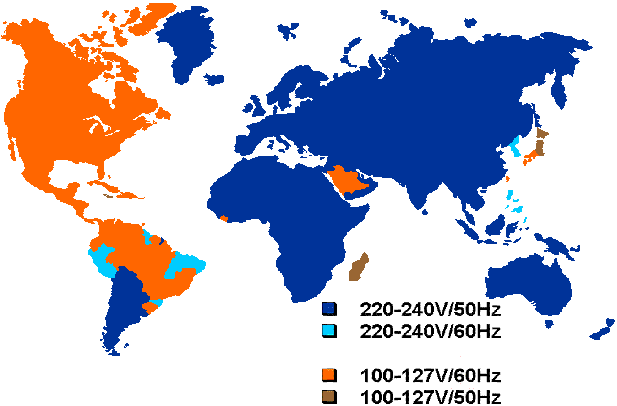
The voltage and frequency of AC electricity varies from country to country throughout the world. Most countries use 220V and 50Hz with about 20% of the countries use 110V and/or 60Hz to power their homes. 220V and 60Hz are the most efficient values, but only a few countries use that combination. The United States uses 110V and 60Hz AC electricity.
|